
The Scottish Haircare Brand Taking On Beauty’s Plastic Problem – And Why it Matters
Main image – Moo & Yoo
There are plenty of beauty brands that talk about sustainability beautifully. Fewer are quite so keen to talk about the admin.
The supplier checks… the packaging compromises… and the unsexy reality of working out where your ingredients come from, what your bottles are made of, and how much electricity your lab uses.
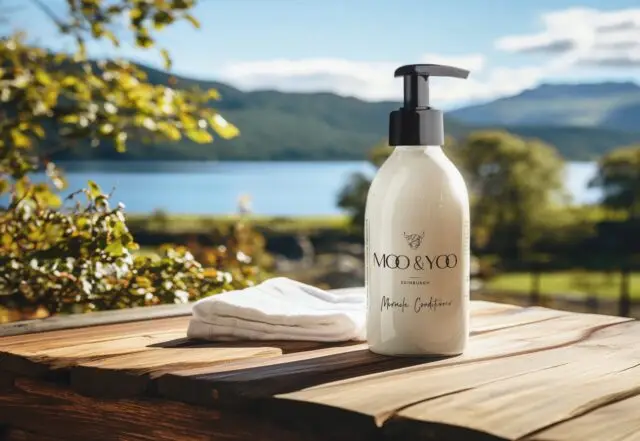
Moo & Yoo, the Scottish hair and body brand founded by salon owner Suzie Gillespie and her daughter Olivia (and a finalist in both our 2025 and 2026 awards, no less), sits firmly in that less glamorous, more meaningful space. The brand is vegan, cruelty-free, packaged largely in glass and aluminium, and now B Corp certified. But its real point of difference may be less about any one credential than the seriousness with which Gillespie seems to take the whole exercise.

Image – Moo & Yoo
Because in beauty, sustainability has become one of those words that is now almost too easy to use and too hard to trust. “Anyone can say they’re sustainable,” Gillespie tells me. “But B Corp makes you prove it.”
Ahead, she explains why she built the haircare brand she couldn’t find for her own salon, what B Corp really asks of a small beauty business, and why taking on beauty’s plastic problem means thinking far beyond the bottle.
“I started to look at the product range and I was really quite shocked”
Moo & Yoo began, in the most practical possible way, with a salon refurbishment. “My background is as a salon owner,” Gillespie tells me. “And just before Covid, around 2019, we did a big refurb and wanted to become an eco salon.”
That meant the things you might expect; low-energy choices, reclaimed timber, a general attempt to make the space align more closely with the values she had begun to care about more deeply. “I think that came from being a mother, thinking about the planet, thinking about what we leave for other people,” she says.
But when she came to the products themselves, the neatness of the idea fell apart. “I started to look at the product range and I was really quite shocked,” she says. “There were a few decent companies, but they were overseas.”
It was while cutting a client’s hair that she found herself saying out loud that she didn’t know where to go next. “He said, ‘Well, why don’t you do it?’” she remembers. “And I said, ‘Well, I don’t make products. I don’t know anything about it.’”
What followed was a partnership with her daughter, a search for the right lab, and a slow, deliberate start. “We weren’t in a rush,” she says.
“I was absolutely horrified by how much plastic was going in there”
If the salon gave Moo & Yoo its starting point, plastic gave it its urgency. “I was absolutely horrified in a salon how much plastic was going in there,” Gillespie says.
At home, an empty shampoo bottle feels insignificant. In a salon, multiplied across clients and treatments, the scale becomes harder to ignore. “You start to think, well, where does this plastic go?” she says. “What happens to it?”
That question became one of the foundations of the brand. Packaging choices – glass bottles, aluminium lids, refill pouches – followed from there, even when they made things more complicated.
Image – Moo & Yoo
“Glass is infinitely recyclable,” she says. “Whereas plastic, even if it ends up in recycling, can only go through so many times.” There are compromises, she admits. There always are. “We don’t pretend that we’re perfect,” she says. “It’s about balance.”
“In a salon, the products have to perform”
The other complication, particularly in haircare, is that good intentions are not enough. “In a salon, the products have to perform,” Gillespie says.
This is where sustainable beauty can sometimes fall down. A shampoo can be beautifully positioned, but if it doesn’t work, the positioning collapses quickly. Gillespie knew the products had to deliver professionally, while also being gentler on both scalp and skin.
“My daughter has suffered with eczema and reactive skin,” she says. “And in the salon, my hands would get irritation as a lot of hairdressers do.”
The result is a line built around avoiding unnecessary harshness, while still accepting formulation realities. “We have preservatives because it has to have a shelf life,” she says. “It’s that balance.”
“Anyone can say they’re sustainable – B Corp makes you prove it”
For a small brand already trying to work responsibly, B Corp certification might sound like an expensive way to confirm what you already know. Gillespie sees it differently.
“For us, it was a trust thing for customers,” she says. “It legitimises what we’re doing.” The process itself is far from straightforward. “They make you jump through hoops,” she adds. “It’s not an easy process.”
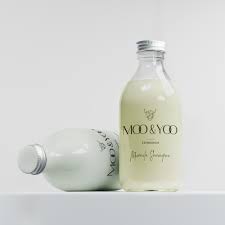
Image – Moo & Yoo
But that, she argues, is precisely the point. “You’re not just saying it – you’ve actually done it.” And once you’ve done it, the work doesn’t stop. “You have to keep updating,” she says. “You can’t just fall away.”
“It definitely opens doors”
The most interesting part of the process may be how far beyond the finished product it reaches. “We need to know exactly where everything is coming from,” Gillespie says.
That includes ingredients like marula oil, sourced through a women’s cooperative in Namibia, and Icelandic moss, harvested under strict conditions. “It’s about making sure it’s done properly,” she says.
Packaging, too, is examined at every stage. “Every supplier has to be looked at,” she explains. The result is a level of scrutiny that extends far beyond what most consumers ever see – and one that increasingly feels necessary.
While the certification process is rigorous, it is also commercially useful. “It definitely opens doors,” Gillespie says.
One recent example is a partnership with the LVMH hotel at the Ardbeg whisky distillery in Scotland. “They wanted a Scottish brand,” she says. “But being B Corp definitely helped.”
For salons, retailers and hospitality spaces, certification offers reassurance. It is not simply a brand saying the right things – it is something that has been tested. “It just gives that level of trust,” she says.
The takeaway
What makes Moo & Yoo interesting is not that it claims to have solved sustainability in beauty. In fact, part of its appeal is that Gillespie does not talk as though anything has been solved.
There are still compromises. There are still trade-offs. There is still, inevitably, waste. But there is also something else, which feels rarer – a willingness to show the workings behind the claims.
And in an industry still learning how to balance performance with responsibility, that may be the more compelling story.


Get Glowing!