How to Choose a Red Light Therapy Device Without Falling for Marketing Claims
SPONSORED
Red light therapy has become one of the fastest-growing at-home wellness technologies in the US, and the market has expanded to match. LED masks, handheld wands, wearable wraps, light pads, compact panels, full-body systems – the options are genuinely overwhelming. More choices sound like a good thing, but when every product claims to be the most powerful, most advanced, or most clinically proven, it gets harder to figure out what actually fits your needs.
The smarter approach is to ignore the superlatives and focus on how different device categories are built for different goals. As more devices enter the market, many consumers rely on educational resources like Red Light Therapy Digest to better understand wavelengths, treatment coverage, and the differences between device formats before committing to a purchase. That foundation matters a lot more than chasing the biggest number on a spec sheet.
Why choosing the right device matters more than choosing the most powerful one
There is no single best red light therapy device. That framing is one of the first marketing traps worth avoiding.
What actually determines whether a device works for you comes down to five things: the treatment area you need to cover, your specific wellness goals, how much time you have per session, your budget, and your lifestyle. A facial LED mask is excellent for skin rejuvenation but does nothing useful for post-workout muscle recovery across your back and legs. A full-body panel is great for whole-body sessions but impractical if you travel frequently or live in a small apartment.
Matching the device to your goal is the decision. Everything else, the wattage, the LED count, the brand name, is secondary to whether the format actually suits what you’re trying to accomplish.
Match the device to your wellness goal
Before comparing any specs, get clear on why you want a red light therapy device in the first place.
Skin rejuvenation
If your focus is fine lines, skin texture, or acne, facial devices are the right category. LED masks and handheld wands deliver targeted wavelengths directly to the face and are designed specifically for skin-level treatment. Full-body panels can cover the face, but they’re not optimised for it.
Hair and scalp care
Hair growth and scalp health require coverage across the entire scalp. Helmets and caps designed for this purpose are built to deliver consistent light to that surface area. A handheld wand used on the scalp is workable but far less efficient.
Muscle recovery
Post-workout soreness and exercise recovery benefit from larger treatment areas. If you’re dealing with general muscle fatigue after training, you need a device that can cover your back, legs, or shoulders without requiring you to hold something in place for 20 minutes.
Joint comfort
Knees, shoulders, and lower back respond well to localized treatment. Wearable wraps and flexible light pads are purpose-built for this, since they conform to the joint and allow hands-free sessions. A large panel works too, but it’s overkill for one knee.
General wellness
For daily relaxation and whole-body sessions, full-body panels or mats offer the broadest coverage and the most efficient use of session time.
Understanding the different types of red light therapy devices
Once you know your goal, the device category becomes obvious. Here’s how the main formats break down.
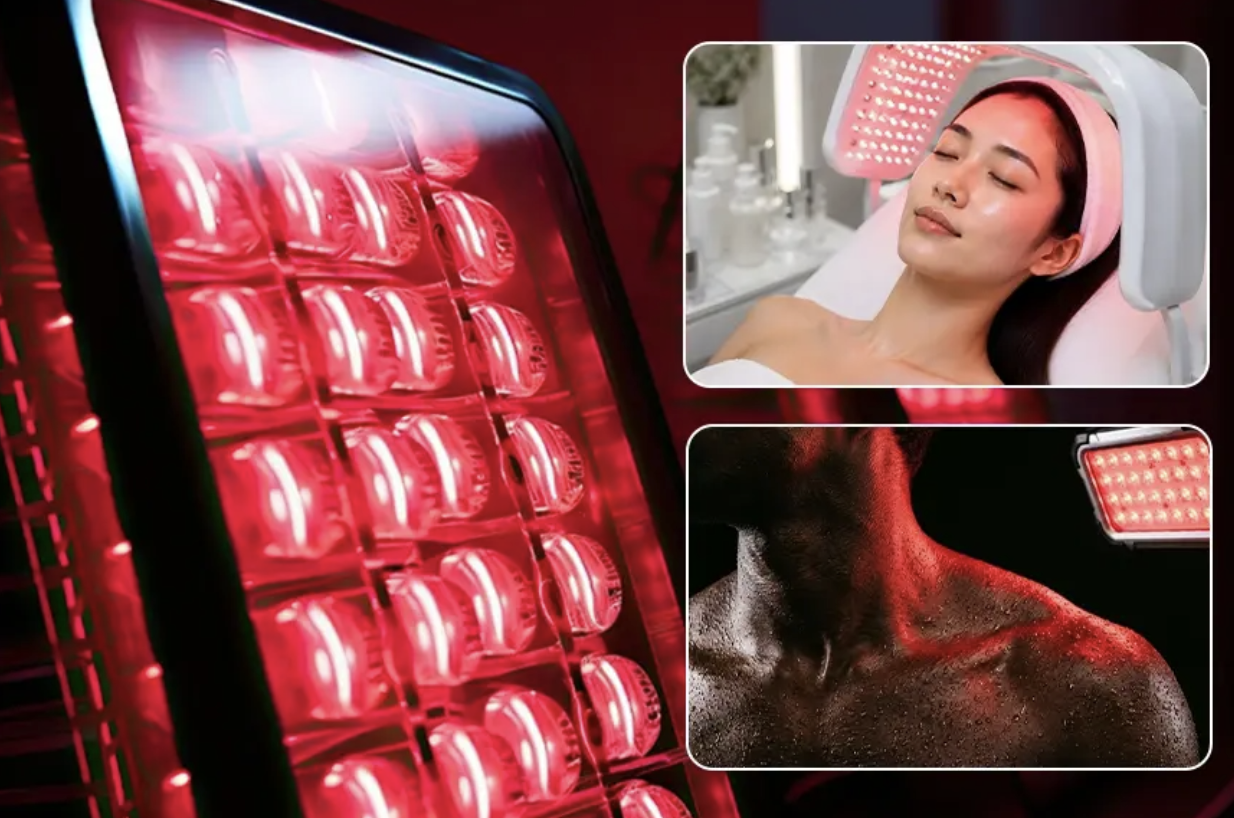
LED face masks cover the full face simultaneously, are hands-free, and are built specifically for skin applications including anti-aging, acne, and tone improvement.
Hair helmets and caps are designed for scalp coverage and are the only practical format for consistent, full-scalp light therapy at home.
Handheld wands are small, portable, and precise. They’re good for targeting specific facial areas or small spots on the body, though full-coverage sessions take longer.
Wearable wraps conform to body parts like knees, elbows, and shoulders. Hands-free use makes them convenient for joint-focused sessions during everyday activity.
Flexible light pads are larger than wraps and can be draped over broader areas like the lower back or thighs. Useful for muscle recovery across a wider surface.
Compact panels sit in a fixed position and work well for medium coverage, face and neck together, or upper body sessions at a set distance.
Full-body panels are the most versatile in terms of coverage and are best suited for users who want comprehensive whole-body sessions as part of a daily wellness routine.
Key features to compare before buying
Getting clear on a few technical basics protects you from being swayed by numbers that sound impressive but don’t tell the full story.
Wavelengths
Red light, typically 630 to 660 nanometers, targets skin-level tissue and is most relevant for skin rejuvenation and surface applications. Near-infrared light, sitting between 810 and 850 nanometers, penetrates deeper and is more relevant for muscle recovery and joint comfort. A device that offers both gives you more flexibility across wellness goals.
Irradiance
Irradiance measures how much light energy reaches the skin per session. Higher irradiance is not automatically better. What matters is whether the irradiance at the distance you’ll actually use the device is sufficient for a therapeutic dose in a reasonable session time. Many brands measure irradiance directly at the LED, which doesn’t reflect real-world use at 6 or 12 inches away.
Treatment area
This is the most underrated spec. A device with great irradiance but a small treatment area will require long, repetitive sessions to cover what you need. Always match coverage to your actual goal.
Ease of use
Timers, simple controls, and a portable form factor determine whether you’ll actually use the device consistently. A device that’s awkward to set up or difficult to position gets skipped. Usability drives consistency, and consistency drives results.
Build quality and warranty
Warranty length and customer support quality matter more than most buyers expect. A one-year warranty on a device you plan to use daily is a short runway. Look for brands that stand behind their products for two years or more.
Real-world examples of red light therapy device types
Looking at real-world examples can help illustrate how different device formats are designed for different purposes. The following products represent several common categories available today and are examples of device types rather than ranked recommendations.
| Device | Category | Best Suited For |
| RLT Home Total Spectrum | Full-body panel | Large treatment areas and full-body wellness |
| Novaa Glow Therapy Mask | LED face mask | Rejuvenate skin, reduce signs of aging, and improve overall complexion |
| My Derma Dream MyoGlow Wand | Handheld wand | Facial skincare and small treatment areas |
| Glokore Red Light Therapy Wrap | Wearable wrap | Targeted muscle and joint support |
| Hooga HG300 Panel | Compact panel | Home wellness and medium treatment areas |
Each of these serves a different user with a different goal. None of them is universally best.
Marketing claims worth questioning
A few phrases show up constantly in red light therapy marketing and deserve a closer look before they influence a purchase decision.
“Instant results” is the most common one. Red light therapy works through cumulative biological processes like collagen remodelling and cellular repair. These take weeks of consistent use, not one session.
“More power is always better” ignores the fact that irradiance needs to be appropriate for the tissue depth and session length. Excessive power at close range can actually reduce efficacy, a concept called biphasic dose response that’s well documented in photobiomodulation research.
“One device does everything” is rarely true in practice. A device optimised for facial skin is not the same as one optimised for deep muscle recovery, even if it technically emits both red and near-infrared light.
Misleading terminology is also common. Words like “medical-grade,” “clinical-strength,” and “FDA-approved” are frequently misused. FDA clearance for general wellness use is different from approval for treating a medical condition. Read the fine print.
When a brand makes clinical claims, look for the actual study being cited. Many referenced studies use different devices, wavelengths, or protocols than what’s being sold.
Tips for making an informed decision
Start with your wellness goal and work backward to the device category. Then compare options within that category using the features outlined above.
Read independent reviews rather than relying solely on brand websites. Third-party testing and user feedback over several months give you a much more honest picture of how a device performs in real life. Comparing multiple red light therapy device reviews can also provide a broader perspective on how different categories perform and which formats may be better suited to specific wellness goals.
Think long-term. The device you’ll use four times a week for six months is worth more than the most advanced model you use twice and forget about. Set realistic expectations and give any device at least eight to twelve weeks of consistent use before evaluating results.
The takeaway
Red light therapy devices come in many formats because different wellness goals genuinely require different approaches. A device built for facial skin rejuvenation and one built for post-workout muscle recovery are not interchangeable, regardless of what the marketing suggests.