
Cream or HRT for Your Skin? What Actually Makes a Difference
SPONSORED
Main image – Ohlamour Studio
With Menopause Awareness Month coming up in October, it feels like a good time to talk about something a lot of us notice but don’t necessarily understand: the way our skin can suddenly change around menopause.
Because there’s a moment, usually somewhere in your late forties or early fifties, when your skin seems to change overnight. The serum that always worked stops doing much. Your face looks a little flatter in photos. Skin that used to bounce back now creases and stays creased.
It’s tempting to blame yourself for not moisturising enough, but the real cause is hormonal, and understanding it changes what you should actually do about it.
The question a lot of women end up asking is which route genuinely helps: a topical cream made for menopausal skin, or hormone replacement therapy taken for the whole body. They work differently, they suit different people, and the honest answer is not one-size-fits-all.
Here’s what the evidence actually shows, so you can have a sensible conversation rather than a guessing game.
Why does skin change so suddenly at menopause?
Skin changes quickly at menopause because oestrogen, which keeps skin firm and hydrated, drops sharply, and collagen falls with it. Oestrogen is not just a reproductive hormone. It plays a direct role in your skin, supporting collagen production, maintaining the skin barrier, keeping skin thick, hydrated and elastic. When it declines, all of those systems weaken at once, which is why the change can feel so abrupt rather than gradual.
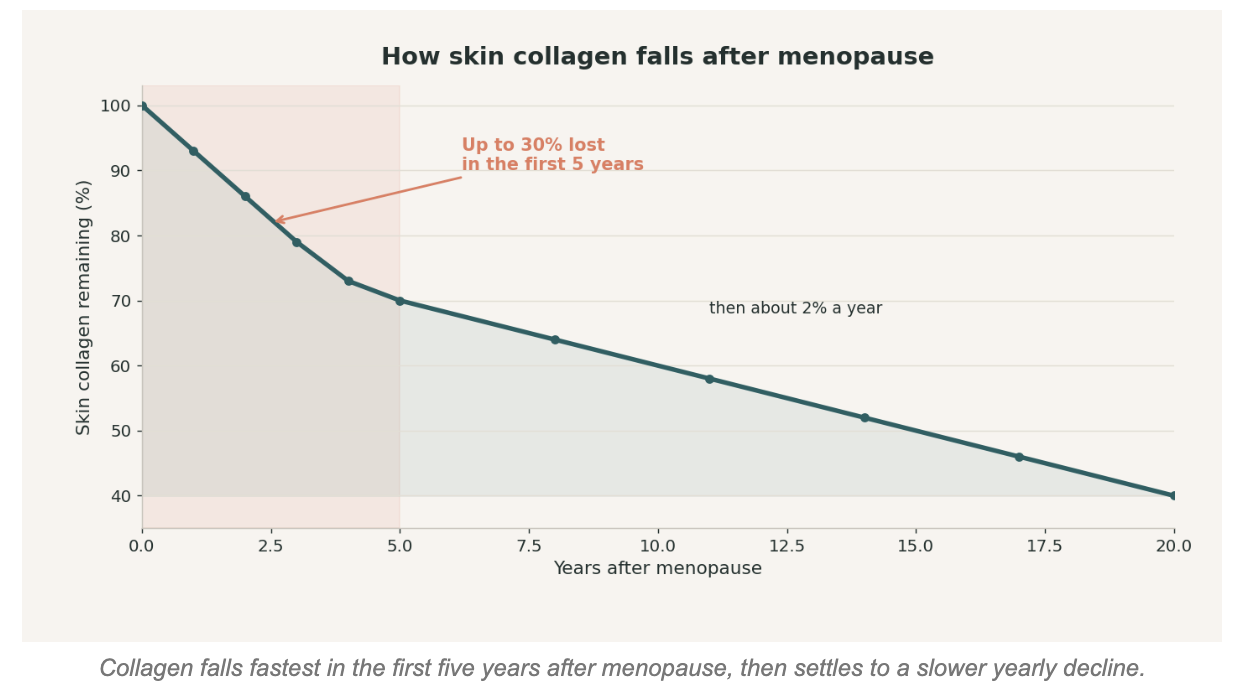
The numbers are genuinely striking. Women lose up to 30% of their skin collagen in the first five years after menopause, then around 2% a year after that. Collagen is the protein that gives skin its structure and bounce, so losing nearly a third of it in half a decade explains exactly why skin can seem to age overnight. Skin thickness drops too, by roughly 1% a year. The rate of this decline tracks oestrogen loss more closely than it tracks your actual age, which is the clearest sign that this is a hormonal shift, not simply getting older.
Why your usual skincare suddenly stops working
Ordinary moisturisers and serums cannot replace collagen that your skin has stopped making, which is why even good products feel like they have stopped working. A moisturiser sits on the surface and improves hydration and texture, which is genuinely useful. But it does nothing about the underlying loss of collagen and the thinning happening in the deeper layers of the skin. You are treating the symptom while the cause carries on regardless.
This is the frustration so many women describe: doing everything right and watching it make less and less difference. The reason a vitamin C serum or hyaluronic acid worked beautifully at 35 and feels pointless at 53 is not that the product changed. It is that the canvas underneath it has. Once you understand that the problem is hormonal, the logic of a hormonal treatment, rather than another cream off the shelf, starts to make sense.
Image – Birgith Roosipuu
It helps to picture the layers. Collagen and elastin live in the dermis, the deeper structural layer of the skin, where they form the scaffolding that holds everything taut. A standard moisturiser works at the surface, in the epidermis, drawing in water and smoothing texture for a few hours. It never reaches the dermis, and even if it did, it contains nothing that tells your skin to make more collagen. That is the gap. The visible signs we read as ageing, the loss of firmness, the way skin folds and stays folded, the thinning around the eyes and mouth, are largely dermal changes. Treating them with a surface product is a bit like repainting a wall while the timber behind it keeps thinning: it looks a little better briefly, then the underlying problem reasserts itself.
This is also why the jump in price between a mid-range moisturiser and a luxury one rarely buys a proportional jump in results during menopause. Past a certain point you are paying for texture, fragrance and packaging, not for anything that addresses the hormonal cause. The thing that genuinely changes dermal collagen in this context is oestrogen, and oestrogen is a prescription medicine, not a cosmetic ingredient, which is the whole reason the conversation moves from the beauty counter to a clinician.
The two hormonal routes: cream versus HRT
There are two evidence-backed hormonal ways to address menopausal skin: systemic HRT that treats your whole body, and a topical oestrogen cream that works mainly on the skin where you apply it. They are not competing products so much as different tools for different priorities.
Systemic HRT, usually oestrogen taken as a patch, gel or tablet, raises oestrogen throughout the body. Because skin responds to that restored oestrogen, HRT has been shown to improve skin thickness, elasticity, hydration and collagen content. For a woman who also has hot flushes, broken sleep, mood changes and the other systemic symptoms of menopause, HRT addresses all of it at once, and better skin comes as part of the package. That is its great strength: it treats the whole picture.
Topical oestrogen, typically estriol cream, takes the opposite approach. Estriol is a weaker form of oestrogen, and applied to the skin it delivers the hormone locally with low systemic exposure. In plain terms, it works mostly where you put it rather than flooding the whole body. For a woman whose main concern is her skin, who does not have significant systemic symptoms, or who would rather not take whole-body hormones, a targeted cream is a more focused option. Studies of topical oestrogen have shown measurable improvements in dermal collagen and skin elasticity in postmenopausal women.
A simplified comparison. The right choice depends on your symptoms, history and goals, decided with a clinician.
So which one actually makes a difference for skin?
Both genuinely work for skin; the better choice depends on whether your concern is your skin alone or your whole experience of menopause. If you are dealing with the full sweep of menopausal symptoms, systemic HRT is likely the more sensible starting point, because it treats everything and your skin benefits alongside the rest. If your symptoms are mild or your real concern is facial skin specifically, a topical estriol skin cream targets the problem where it shows, without committing you to whole-body hormone therapy you may not otherwise need.
There is also a timing point worth knowing. Because collagen falls fastest in those first few post-menopausal years, starting treatment sooner tends to preserve more than starting late. Some research suggests hormonal treatment helps skin most when begun within the first couple of years after menopause. That is not a reason to panic if you are further along, treatment still helps, but it is a reason not to keep putting the conversation off.
What both routes are not
Neither cream nor HRT is a substitute for the basics, and neither erases years of sun exposure. A great deal of visible skin ageing comes from photodamage and environmental exposure, which oestrogen does nothing about. Daily SPF, not smoking, and a sensible routine with proven actives like retinoids still matter enormously, and they work alongside hormonal treatment rather than being replaced by it. Hormonal options address the menopausal layer of the problem specifically; they are powerful for that, and silent on the rest.
It is also worth being clear-eyed about safety. Both routes need a clinician’s involvement, and topical oestrogen is generally not suitable for women with a personal or family history of certain cancers. Long-term safety data for facial use of topical oestrogen is more limited than the decades of data behind standard HRT, which is exactly why ongoing medical oversight matters rather than buying something unregulated online.
And manage your expectations sensibly. Hormonal treatment can restore firmness, hydration and a measurable amount of collagen, and many women genuinely see their skin look plumper and more resilient over a few months. What it will not do is turn the clock back to your thirties or erase deep set wrinkles entirely. Think of it as slowing and partly reversing the menopausal slide, not as a face-lift in a tube or a tablet. The women who are happiest with the results are the ones who started with realistic goals: better skin for their age, not someone else’s skin.
The takeaway
If your skin has changed since menopause, that is real, it is hormonal, and a cream off the shelf was never going to fix it because the problem sits below the surface.
The two treatments that genuinely address it are systemic HRT, best if you have wider menopausal symptoms, and topical estriol cream, best if skin is your main concern and you would rather keep things local. Start the conversation with a clinician sooner rather than later, keep your SPF and good routine going regardless, and choose the route that fits your symptoms and your priorities, not the one with the loudest marketing.
FAQs
Does menopause really affect your skin that much?
Yes. Women lose up to 30% of skin collagen in the first five years after menopause as oestrogen declines, causing thinning, dryness and loss of elasticity. The change is hormonal, not simply ageing.
Can a normal moisturiser fix menopausal skin?
Not fully. Moisturisers improve surface hydration and texture but cannot replace lost collagen or rebuild skin thickness, which is why even good products often feel less effective after menopause.
What is the difference between HRT and estriol cream for skin?
HRT raises oestrogen across the whole body and treats wider menopause symptoms too. Topical estriol cream delivers oestrogen mainly to the skin where applied, with low systemic exposure, making it a more targeted option for skin alone.
Is estriol cream safe to use on the face?
It can be, under clinical supervision, but it is generally not suitable for women with a personal or family history of certain cancers. Long-term facial safety data is more limited than for standard HRT, so medical oversight is important.